The Challenge: To spend at least 1 hour capturing one subject.
The Plan: To use a lens ball when photographing an autumn leaf outside in nature
I was beginning to despair that I would be able to complete this challenge. Autumnal colour had not fully arrived in my home town and we were heading into stormy weather. I had hoped to get to a local woodland, to find a leaf and then to photograph it within the woodland using my lens ball to creative effect and to show the leaf in its location giving it context.
Last week, when sitting in my lounge on a rainy day looking out of the window, I noticed an autumnal coloured leaf that had fallen from a nearby witch hazel tree and hooked itself onto a rose bush below. It had been illuminated by a brief show of light. I had an overwhelming sense that I should collect the leaf and bring it inside before it blew away. I had planned to take it out with me later in the day but with the weather still poor, I set up a spot in my craft room to study the leaf and to see what I could create. I placed a sheet of white paper on the windowsill so that I would hide potential distractions and have some natural light to illuminate it. I then placed anLED light set to a warm yellow tone to the right of the leaf which created some warmth and lifted the colours of the leaf.
I began with an OM 8–25mm lens on my OM1 MKII and captured a series of 15 images using the focus stacking program, later stacking them in Photoshop and editing them in Lightroom. I could have used the in camera JPEG but I prefer to use the raw files to create a final image when possible.
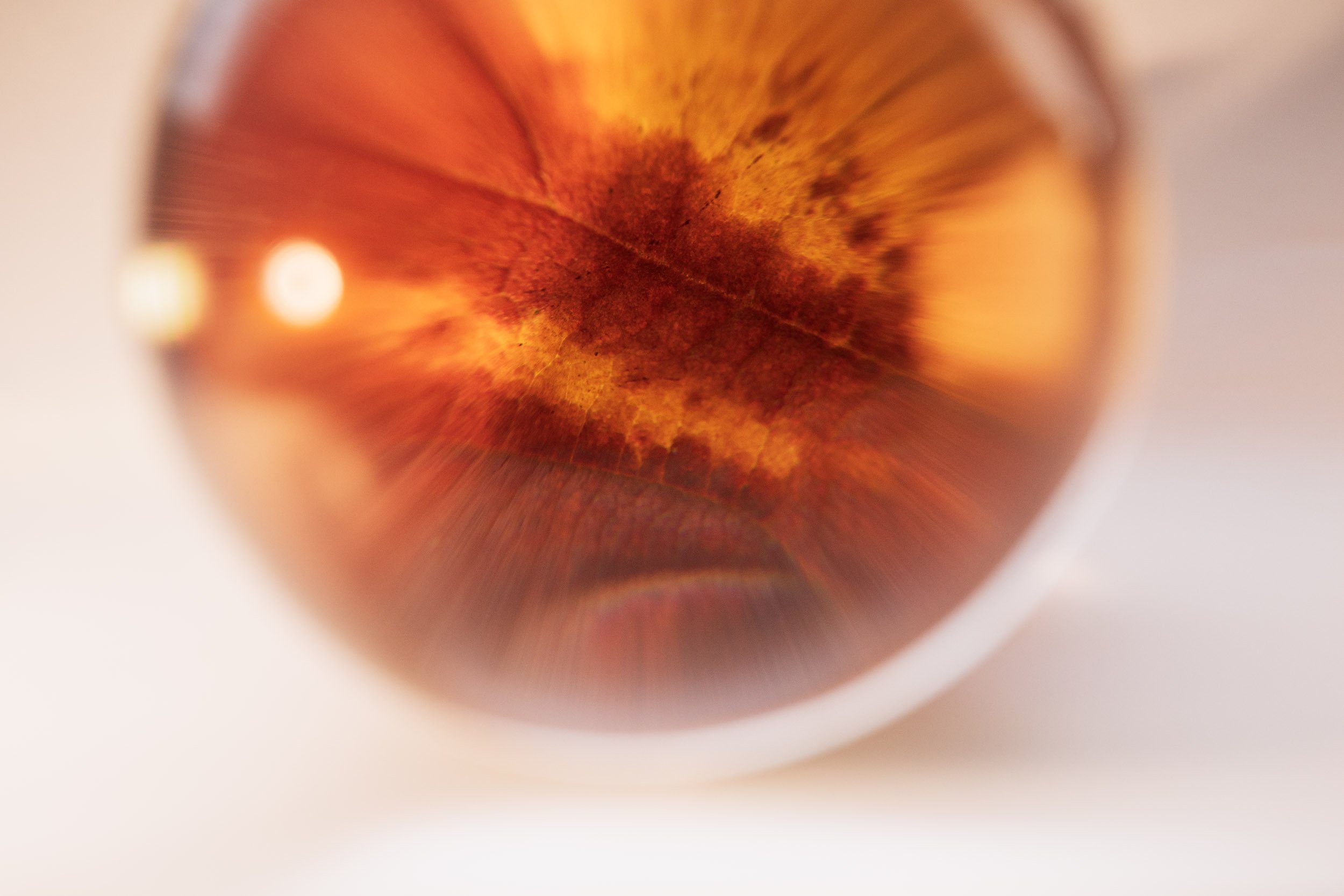
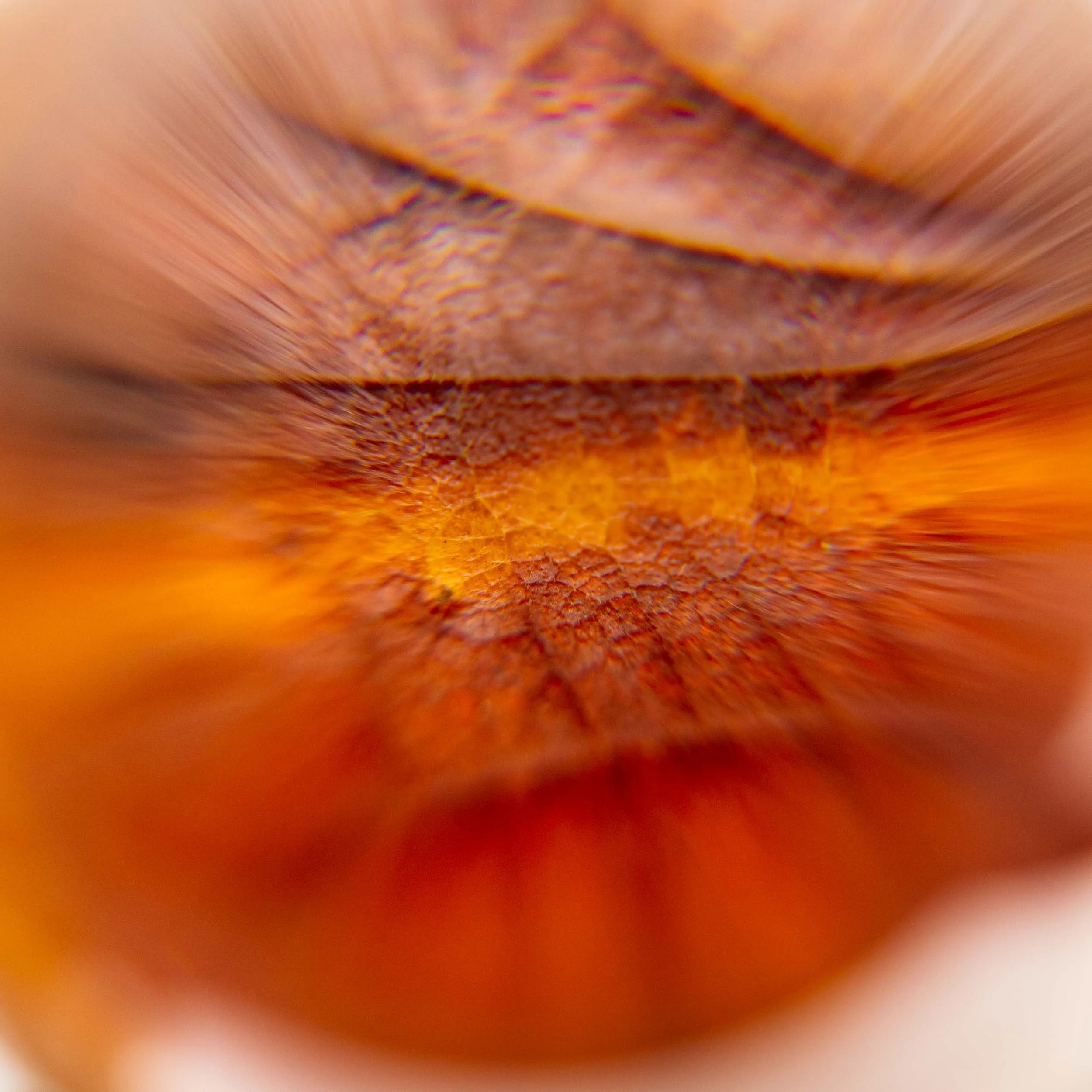
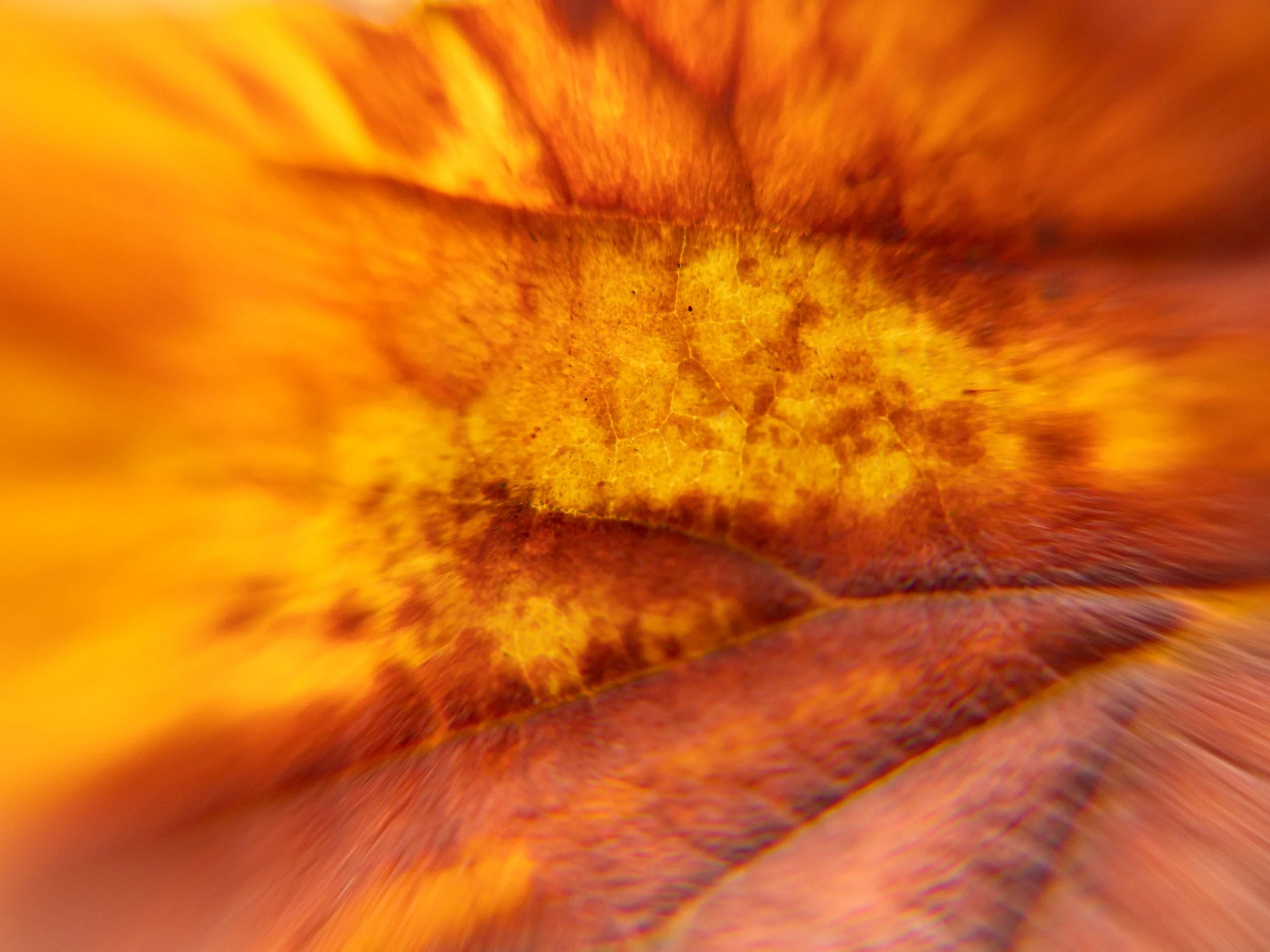
My plan had been to explore what was possible with my lens ball. Because I could not rely nature to provide the backdrop I decided that I needed to get close enough to the lens ball to fill it with the leaf. The 3 images below show how the look of the leaf altered at various distances. The second of the images reminds me of the folds of an eyelid with the lashes splaying out. Having captured these 3 images, I felt that the ball was limiting my creativity and so decided to put it to one side.
I decided to add a further small LED light with a warm coloured filter and to change to an OM 60mm macro lens before taking the close up image below of part of the leaf. Again this was a stack of 15 images. It is incredible how much detail has been captured with the smallest of fibres becoming clearly visible on a small section of leaf with the rest of the image falling out of focus.
Staying with the same lens, I decided to try ICM to see what I could achieve and I created the image below. I loved the result and it is definitely my favourite of the images taken. I love that you still get a sense of the original leaf although it now appears as part of a flower. I also love the autumnal colour palate which has been "pulled" through the image. I took this image horizontally but having noticed the similarity to a flower I rotated it to a vertical image when editing it in Lightroom.
I Learned that:-
Spending an hour photographing a single subject taught me how much depth and variety can be found in focused observation.
I needed to think more creatively about what I could achieve. I was not able to rely on nature to provide context and a backdrop to the leaf. I had to explore other ways of making compelling images.
Technically, the hour reinforced the value of patience and small adjustments: slight changes in aperture, focal point, or movement of the camera produced markedly different moods. It reminded me that an image doesn’t need every detail to be powerful (as with the ICM), but the details are there if I choose to reveal them — and they can transform a simple subject into something richly textured and intimate.
I learned that the tone of light on the leaf affected its overall appearance very considerably. Blue and green tones meant that the leaf looked dark and lack-lustre. Red tones led to the leaf looking over saturated and unnatural. Orange and yellow light created a warmth which enhanced the natural colours of the leaf and brought out the textures and colour variations.
Even though my favourite result from the session is the ICM image, with its painterly sweep and limited detail, the time spent also revealed the quieter, intricate features of the leaf. Studying its network of veins made me aware of repeating patterns, tiny textures and the way light sculpts surface relief. I noticed subtle shifts in tone and colour across just a few millimetres — warm tones fading to cooler shadows, highlights that moved as I changed angle, and delicate veins catching light differently depending on the lens and exposure.
Looking ahead, I want to take these lessons outdoors. In the studio I can control light, backgrounds and equipment; on location I’ll need to rely more on what I carry and on creative problem-solving. I’m excited to experiment with translating the ICM’s abstraction and the leaf’s delicate detail into natural settings — combining deliberate camera movement, selective focus and careful attention to small patterns found in the landscape. Ultimately this practice has sharpened my observation, broadened my technical choices and given me new directions to explore in making images that balance mood, texture and colour.